|
|
|
|
| |
BACKGROUND |
|
|
| |
|
|
|
| |
At the
7th International
Congress of Plant Pathology (Edinburgh 1998) a Special Public
Meeting was convened on ... |
|
|
| |
|
|
|
| |
Global Food Security: The Role for Plant Pathology
|
|
|
| |
|
|
|
| |
It was addressed by five speakers including Norman
Borlaug, plant pathologist and winner of the Nobel Peace Prize in
1970 for his work on food security (he died in 2009). He
challenged
ISPP to take action to support global food security through control
of plant diseases. ISPP's Task Force on Global Food Security was set up
in 1998 in response to his challenge. |
|
|
| |
|
|
|
| |
ISPP provided a background brief for the 1998 meeting. It is
developed here with content updated to 2016, and compared with
background material prepared for later Congresses. |
|
|
| |
|
|
|
| |
 1998
(Edinburgh) 1998
(Edinburgh)
2003
(Christchurch)
2008
(Torino)
2013
(Beijing)
2018
(Boston) |
|
|
| |
|
|
|
|
|
|
|
| |
THE ENORMITY OF THE PROBLEM OF GLOBAL FOOD SECURITY
|
|
|
| |
|
|
|
| |
Of the
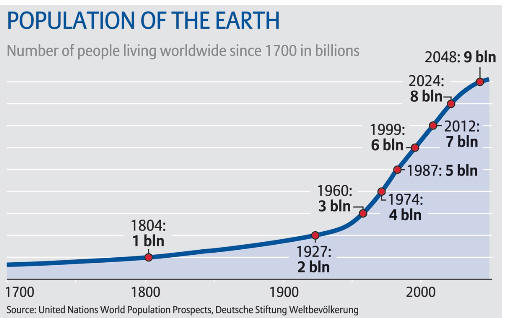
global population of more than 7 billion people, some 800 million do not
have enough to eat today. The vast majority of these people live in
developing countries (FAO
2015). By 2050, the global population is expected to exceed 9
billion (US
Population Division). |
|
|
| |
It has been
estimated that pathogens and pests reduce global production of the five major
crops (wheat, rice, maize, potato and soybean) by 20-30%, and that the greatest
losses are associated with food-deficit regions (Oerke
& Dehne 2004;
Savary et
al. 2019).
|
|
|
| |
|
|
|
| |
Plant pathologists cannot ignore the juxtaposition of these
figures for food shortage and the damage to food production caused by
plant diseases. |
|
|
| |
|
|
|
| |
During the World Food Summit in Rome in 1996, Heads of States agreed
to halve the number of hungry people by 2015, relative to 1990-92.
Significant progress has been made, despite substantial increase in the
global population, but there are still 800 million hungry people. The
Millennium Development Goals of 2000 set a target of halving the
proportion of the world's hungry people by 2015. This target has almost
been achieved. But despite overall progress, much remains to be done to
eradicate hunger and achieve food security (FAO
2015). |
|
|
|
|
|
|
| |
Global crop production needs to be substantially increased
to meet the demands of a growing population. |
|
|
| |
|
|
|
| |
For the 11th International Congress of Plant Pathology 2018, the Task Force
led the development of three sessions devoted to food security under the overall
theme:
Emerging Plant Diseases: The Threat to Global Food
Security
Public
Meeting at Harvard Museum of Science - Crop Diseases Threaten Global Food
Security and Your Breakfast
Emerging
Plant Diseases and Global Food Security (Keynote Session)
Innovative
Technologies for Monitoring Emerging Diseases (Concurrent Session)
The content of the presentations under these three headings was representative
of issues limiting food security in 2018. They form the outline of an ISPP book
to be based on presentations at the Boston Congress, Plant Diseases and Food
Security in the 21st Century, one of a series on
Plant
Pathology in the 21st Century. One of its chapters includes this summary of
some challenges of food security at that time.
The uncertainty of food security calls for innovative
solutions in order to meet the 2030 Agenda for Sustainable Development and in
particular the United Nations Sustainable Development Goals (SDGs). The 2030
Agenda for Sustainable Development, adopted by all United Nations Member States
in 2015, is based on 17 SDGs, requesting global partnerships across developed
and developing countries to create strategies that improve health and education,
reduce inequality, and increase economic growth (Sustainable
Development Goals, 2017).
Smallholder farmers in developing countries, who produce enough food to feed
their families with some surplus to sell at the local market, comprise one of
the main groups to be affected by emerging plant pests and diseases, with
subsequent yield loss. Approximately 500 million smallholder farmers provide
over 80% of the food for a large part of the developing world (International
Fund for Agricultural Development, 2013).
Achieving a world without hunger by 2030 depends on increasing the productivity
of smallholder farmers; however, their crops face significant threats. Yearly,
an estimated 25-40% of six major crops grown worldwide is lost to pests (Oerke,
2006;
Savary et al., 2019). If crop losses were reduced
by as little as 1%, millions more people could be fed. A key challenge is to
deliver appropriate, actionable extension advice to farmers, at the right time,
to help them reduce crop losses. |
|
|
|
|
|
|
| |
WHY DO PLANT DISEASES MATTER? |
|
|
| |
|
|
|
| |
Pathogens and pests reduce production of the five major crops by some 20-30%
(Oerke
& Dehne 2004;
Savary et
al. 2019). |
|
|
| |
|
|
|
|
|
|
|
| |
Historically, plant diseases have had catastrophic impact
|
|
|
| |
|
|
|
| |
Potato
blight caused the Irish famine in 1845
Brown
spot of rice caused the Great Bengal Famine of 1943
Southern
corn leaf blight caused a devastating epidemic on the US corn crop in
1970 |
|
|
| |
|
|
|
|
|
|
|
| |
At present, food security is threatened by plant diseases
|
|
|
| |
|
|
|
| |
Wheat
blast
Banana
xanthomonas wilt |
|
|
| |
|
|
|
|
|
|
|
| |
|
|
|
|
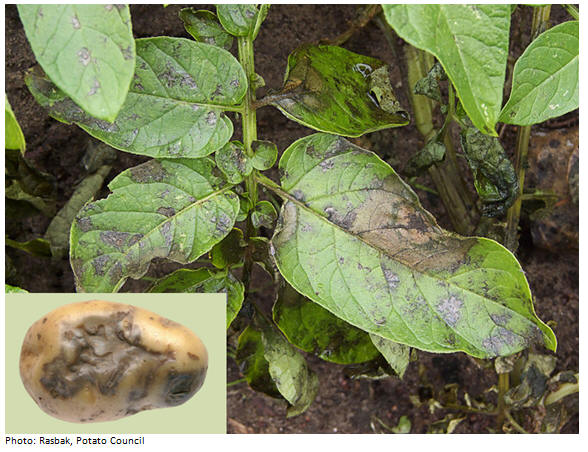 Potato blight, caused by the fungus Phytophthora
infestans
Potato blight struck Europe like "a bolt from the blue" in the
1840s. In Ireland, about a million people died of starvation and rather
more than a million attempted to emigrate. The reasons for this calamity
were the arrival in Europe of a virulent strain of the pathogen, the
high dependence of much of the Irish population on potato for
sustenance, the lack of resistance in the plant to the pathogen, and
weather conditions favorable to epidemic development (Strange
& Scott 2005). |
|
|
| |
|
|
|
|
|
|
|
| |
|
|
|
| |
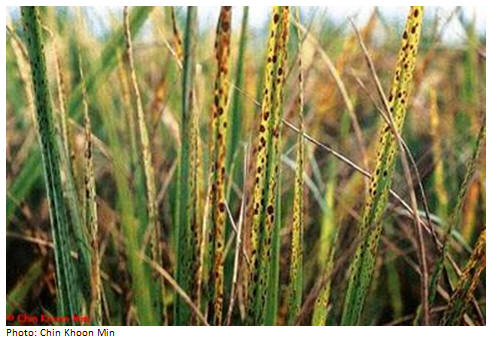 Brown spot of rice caused by the fungus
Cochliobolus miyabeanus
Brown spot of rice was a major cause of the Great Bengal Famine of
1943, in which at least 1.5 million people died. Favourable weather
conditions for the fungus resulted in an epidemic which reduced the
yield of rice crops by 40-90%. Most of the population was dependent on
rice as a single crop. The devastating famine that followed was
exacerbated by hoarding and over-pricing in the prevailing atmosphere of
political uncertainty and fear. |
|
|
| |
|
|
|
|
|
|
|
| |
|
|
|
| |
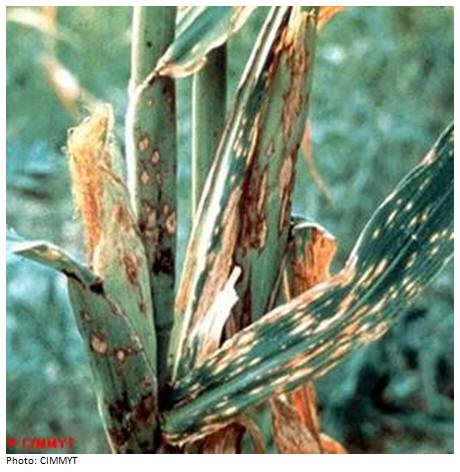 Southern corn leaf blight of maize caused by the
fungus Cochliobolus heterostrophus
A devastating epidemic of southern corn leaf blight occurred on the
maize crop in the USA in 1970, due to the rapid evolution of a new race
of the pathogen, Race T. This race was specific for maize cultivars with
T-cytoplasm, which was in widespread use because it conferred male
sterility, thereby facilitating the production of hybrid seed. The
resulting genetic uniformity of the maize crop rendered it extremely
vulnerable to the new race. |
|
|
| |
|
|
|
| |
|
|
|
|
|
|
|
| |
Some diseases are critically threatening now |
|
|
| |
|
|
|
| |
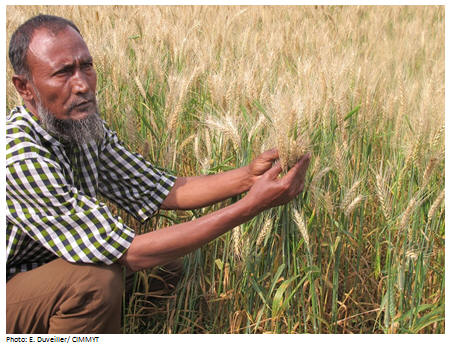 Wheat blast caused by the fungus Magnaporthe
oryzae
One of the most fearsome wheat diseases in recent decades, according
to CIMMYT, wheat blast can shrivel the grain in less than a week. First
sighted in Brazil in 1985, blast is now widespread in South America. In
2016 there was a severe outbreak in Bangladesh. The spread of wheat
blast could be devastating to South Asia, home to 300 million
undernourished people. There is an urgent need for better understanding
of this emerging threat, with the development of control measures and
especially selection of resistant cultivars of wheat. |
|
|
| |
|
|
|
|
|
|
|
| |
|
|
|
| |
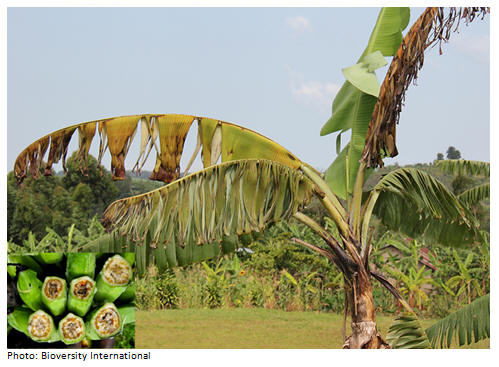 Banana xanthomonas wilt caused by the bacterium
Xanthomonas campestris pv. musacearum
The banana crop provides more than 25% of the food requirements of
100 million people, mostly in Africa. Since the discovery of the banana
xanthomonas wilt (BXW) bacterium in 1968, and its rapid subsequent
spread, production has been severely threatened. BXW kills the mother
plant which cannot then produce the subsequent ratoon crop by vegetative
reproduction. Infected areas cannot be replanted due to carryover of
soilborne inoculum. |
|
|
| |
|
|
|
|
|
|
|
| |
WHAT ISPP'S COMMISSION ON GLOBAL FOOD SECURITY CAN DO ...
some examples |
|
|
| |
|
|
|
| |
Faced with the huge challenge of global food security, ISPP's Commission of some 20
people has to focus its resources on realistic aims.
Guided by
Norman Borlaug's challenge, the Task Force aims to take
action to support global food security through control of plant
diseases. Some examples follow. |
|
|
| |
|
|
|
|
|
|
|
| |
Food security focus at plant pathology congresses
|
|
|
| |
|
|
|
| |
At the series of International Congresses of Plant Pathology, the
programmes have featured plenary discussion sessions on Global Food
Security, normally open to the public. Follow the links to see the
detail. |
|
|
| |
|
|
|
| |
1998 (Edinburgh)
2003 (Christchurch)
2008 (Torino)
2013 (Beijing)
2018 (Boston) |
|
|
| |
|
|
|
|
|
|
|
| |
A new journal, Food Security |
|
|
| |
|
|
|
| |
This
journal is the initiative of a distinguished international group of
scientists, sociologists and economists who hold a deep concern for the
challenge of global food security, together with a vision of the power
of shared knowledge as a means of meeting that challenge. It has been
commended by
Norman Borlaug for addressing the constraints - physical, biological
and socio-economic - which not only limit food production but also the
ability of people to access a healthy diet. |
|
|
| |
|
|
|
|
|
|
|
| |
Supporting cassava farmers in Ghana |
|
|
| |
|
|
|
| |
More than half of the farming population of Ghana are cassava
growers. The
ISPP Congress Challenge Award was won by the Crops Research
Institute (Ghana) to help farmers in the Volta region to recognize when
their crops were diseased and then to develop disease control strategies
to improve food security and enhance income generation. The project
Report describes how 60 farmers participated in farmer field school
activities and were encouraged to transfer skills and techniques to
their neighbours. A
Disease
Guide was published and a DVD on cassava diseases and their
identification for schools and agricultural extension agents. |
|
|
| |
|
|
|
|
Raising public awareness of plant diseases in Southern
Africa |
|
|
| |
|
|
|
| |
A further
Challenge Award was won by the University of Pretoria for a project
to improve awareness of the impact and importance of plant disease for
food security. A mobile lab, "Plant Pathology on Wheels", was developed
for use in schools and at public. The
project report features a tour with undergraduate plant pathology
students to Mozambique, Swaziland and South Africa. A DVD on
"Plant pathology as a career"
was produced. |
|
|
| |
|
|
|
|
|
|
|
| |
Reviews and Position Papers on food security issues
|
|
|
| |
|
|
|
| |
The Commission supported a widely cited review "Plant
disease: a threat to global food security"
in Annual Review of Phytopathology. There are sections on: What are the
threats? How serious are the threats? How can the threats be minimized?
The challenge of the future. The summary includes these two quotations:
"Catastrophic plant diseases exacerbates the current deficit of food
supply." "At the political level, there is a need to acknowledge that
plant diseases threaten our food supplies and to devote adequate
resources to their control."
A chapter on "ISPP
and the Challenge of Food Security" was published in the book The
Role of Plant Pathology in Food Safety and Food Security. It is noted
that "Although there are many reasons for food insecurity such as
inhospitable climate, poor soil, inadequate access to food, trade
barriers and political constraints, plant diseases have a fundamental
role to play as they decrease yields, destroy crops or make their
cultivation impossible". |
|
|
| |
|
|
|
| |
Members of the Commission have published the first of a series of
Position Papers on current issues: "Genetic
modification for disease resistance: a position paper". It
concludes: "The ISPP Task Force on Global Food Security considers that
there is untapped potential for using GM to introduce resistance to more
pathogens in a wider variety of crops. The Task Force advocates an
objective approach to assessment and application of the potential of GM,
as one means of addressing the severe impact of plant disease on food
security".
Further Position Papers are planned on Fungicides and
on Phytosanitary Issues. |
|
|
| |
|
|
|
|
|
|
|
| |
Knowledge base on plant diseases and food security
|
|
|
| |
|
|
|
| |
A series of databases concerned with plant pathology food security
is under development at the University of Pretoria on: |
|
|
| |
|
|
|
| |
Conferences
Institutions
Funding
Sources
Think
Tanks |
|
|
| |
|
|
|
|
|
|
|
| |
AIM OF THE COMMISSION, updated 2015 |
|
|
| |
Formerly (1998-2018) ISPP Task Force on Global Food Security |
|
|
| |
|
|
|
| |
The aim of the ISPP Task Force on Global Food Security is to foster
linkages between plant pathology and key food security challenges, to
promote understanding of the issues and to facilitate action to sustain
global food security.
This is to be achieved through a
balanced program including the fostering of institutional linkages and
action-based projects. The Task Force will serve as a platform for
information exchange, for example through the Food Security journal, and
through knowledge bases, position papers, think tanks and conferences.
Progress towards the aim will require funds to be raised.
The
aim reflects the activities proposed at the formation of the Task Force
in 1998 - responding to Norman Borlaug's challenge to action by ISPP and
now forming part of the workplan of ISPP - including action to influence
public policy and opinion on global food security through increased
awareness of the significance of plant diseases. |
|
|
| |
|
|
|
|
|
|
|
| |
THE COMMISSION IN THE HISTORY OF ISPP |
|
|
| |
|
|
|
| |
The development of the Commission as a distinctive element in ISPP's
programme is covered in detail in
History of the
International Society for Plant Pathology. |
|
|
| |
|
|
|
| |
Members of the
Commission |
|
|
| |
|
|
|
| |
|
|
|
| |
Return to the top |
|
|
| |
|
|
|
| |
|
|
|
| |
|
|
|
| |
|
|
|
| |
|
|
|
| |
|
|
|
| |
|
|
|
| |
|
|
|
| |
|
|
|
| |
|
|
|
| |
|
|
|
| |
|
|
|
| |
|
|
|
| |
|
|
|
| |
|
|
|
| |
© The International Society for Plant Pathology Inc. All rights reserved.
Website: Peter Williamson Revised: 28/04/2021 09:04:17 AM
|
|
|